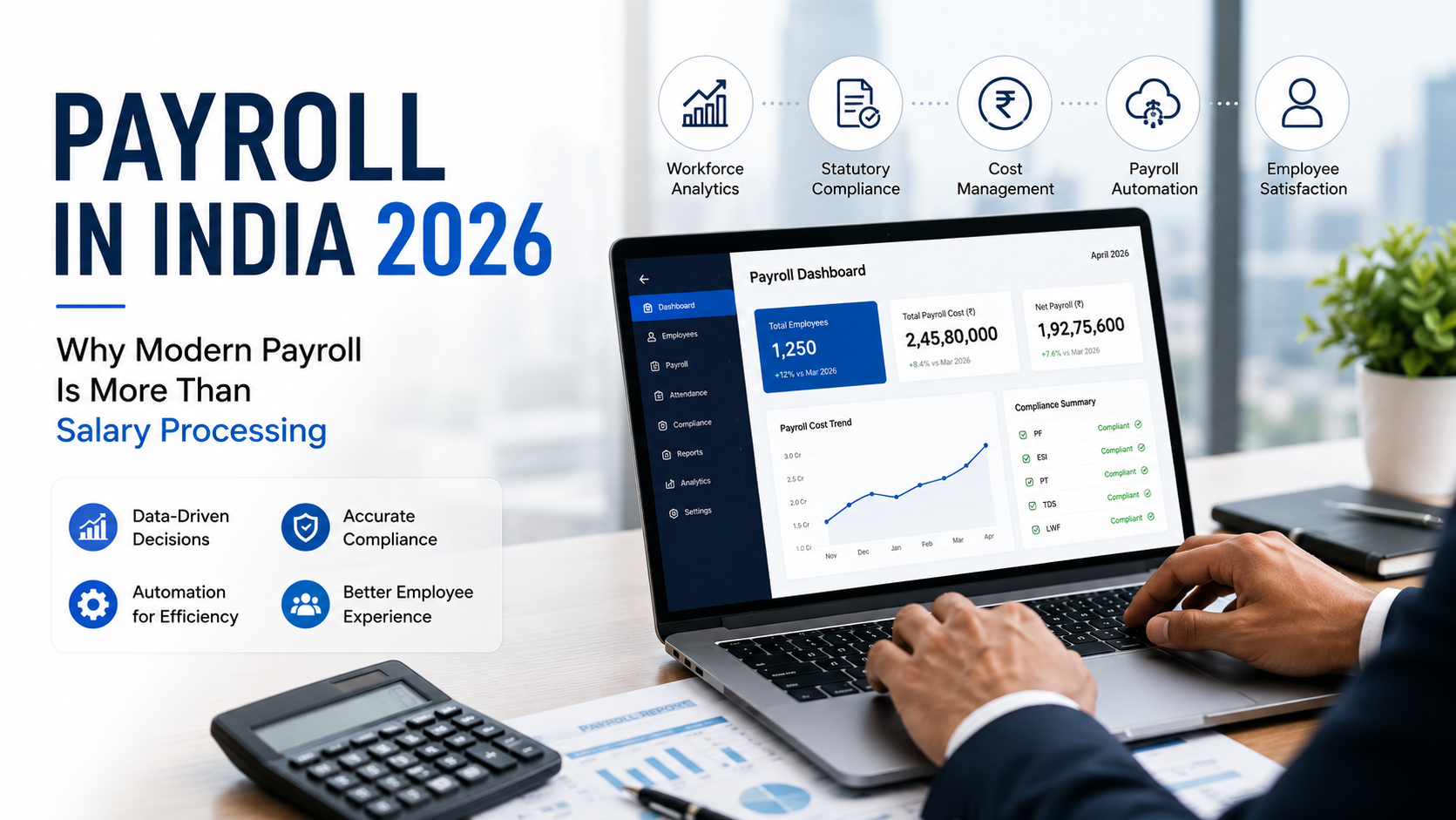
For years, payroll in India was treated as a monthly administrative exercise: calculate salaries, deduct taxes, process PF and ESI, generate payslips, transfer salaries, and close the month. But that definition of payroll is becoming outdated.
In 2026, payroll in India 2026 is increasingly connected to workforce planning, compliance, employee experience, and business decision-making. New regulations, distributed teams, multiple locations, changing compensation structures, and rising expectations for transparency are making payroll more complex — and far more critical.
ADP's 2026 Future of Pay research in India found that 94% of organisations surveyed use payroll data for workforce decisions, including hiring, retention, and cost management. The research also revealed that six in ten organisations use payroll data for budget simulations.
That means payroll is no longer simply the final step after HR makes a decision. Increasingly, payroll data is becoming part of the decision itself.
- What Is Changing About Payroll in India in 2026?
- Payroll Is Moving From Administration to Decision-Making
- Why Payroll Accuracy Still Matters Most
- The Problem With Spreadsheet-Based Payroll
- Payroll, HR and Attendance Should Not Operate in Silos
- Payroll Compliance Is Becoming More Complex
- The Labour Codes Make Payroll Readiness Even More Important
- Payroll Data Can Help Control Workforce Costs
- Payroll Is Also Becoming an Employee Experience Function
- AI Is Entering Payroll — But Automation Should Come First
- What Should a Modern Payroll System Provide?
- Payroll Software vs Manual Payroll: What Changes?
- 7 Payroll Metrics HR Leaders Should Track in 2026
- Frequently Asked Questions
What Is Changing About Payroll in India in 2026?
The payroll function is being transformed by several macroeconomic and regulatory shifts happening simultaneously. In 2026, companies managing payroll in India must navigate:
- More complex, flexible salary structures
- Multiple branch locations and divergent state-level compliance mandates
- Changing statutory regulations and upcoming Labour Code rules
- Hybrid, remote, and distributed workforce models
- Variable pay, commissions, and performance incentives
- Overtime and shift-based rosters for frontline employees
- Increasing employee expectations around transparent pay
- Surging demand for real-time workforce cost analytics
- Integration between HRMS software, attendance management, and payroll systems
ADP's 2026 India research identifies rising workforce costs, frequent statutory updates, pressure for accurate headcount reporting, and stringent governance among the primary drivers pushing payroll to the boardroom table. For HR teams, this raises a crucial question: Can your payroll system keep up with how your workforce operates today?
Payroll Is Moving From Administration to Decision-Making
Traditional payroll systems primarily answered one question: "How much should we pay each employee?"
Modern payroll software in India needs to answer far more strategic business questions:
- What is our true total cost to company (CTC) and net workforce expenditure?
- Which departments are trending over their quarterly salary budgets?
- How much are overtime payments increasing month-over-month?
- What is our average revenue versus labour cost per employee?
- What is the projected financial impact of a revised hiring or compensation plan?
- How much statutory liability (PF, ESIC, Gratuity) are we carrying on our balance sheet?
- What is the financial cost of employee turnover and attrition?
- Which branch locations have the highest payroll overheads?
A unified payroll management system connected with attendance and HR records gives leadership a real-time, consolidated picture of labour economics.
Why Payroll Accuracy Still Matters Most
Adopting strategic payroll does not mean baseline accuracy is any less vital. In fact, the opposite is true: if underlying payroll calculations are flawed, every downstream financial report and leadership decision built on that data becomes untrustworthy.
Payroll miscalculations jeopardize:
- Net take-home salaries and employee trust
- Provident Fund (PF) and ESIC remittances
- State-wise Professional Tax (PT) and Labour Welfare Fund (LWF)
- Tax Deducted at Source (TDS) and Form 16 filings
- Leave encashment, overtime pay, and reimbursements
- Full & Final settlement (F&F) and gratuity calculations
This is why effective automated payroll India is not just about "calculating salaries faster" — it is about establishing a compliant, auditable, and automated pipeline: Capture accurate data → apply the right statutory rules → calculate correctly → maintain records → generate instant reports.
The Problem With Spreadsheet-Based Payroll
Spreadsheets are ubiquitous among startups and small businesses. When headcount is small and compensation structures are static, Excel can suffice. However, as an organisation scales, manual spreadsheets become a significant liability.
Consider a growing enterprise with 300 employees across 4 branches, various shift rotations, variable sales incentives, regular new hires, and exits. Managing this across fragmented Excel sheets exposes the business to:
Manual Data Entry & Duplicate Records
HR teams waste days manually re-entering attendance marks, leave deductions, and new hire bank accounts into disparate spreadsheets.
Formula & Calculation Errors
A single misplaced cell reference or formula error can propagate incorrect TDS deductions or underpay statutory PF across hundreds of payslips.
Lack of Real-Time Visibility & Audit Vulnerability
Management lacks real-time headcount visibility, and statutory auditors face immense hurdles attempting to trace how net pay was derived months prior.
Payroll, HR and Attendance Should Not Operate in Silos
One of the greatest operational breakthroughs in modern payroll is end-to-end integration. An employee's monthly salary depends directly on attendance: total workdays, approved leaves, biometric punches, late marks, overtime hours, and weekly offs.
When attendance lives in one machine and payroll in another, HR is forced to export CSV files, reconcile anomalies manually, and re-upload batches. An integrated HRMS payroll system automates this entire pipeline:
Employee Master → Biometric/GPS Attendance → Leave Engine → Overtime → Payroll Run → Automated Payslip → Bank Transfer → MIS Reports
HR Niti, for instance, natively integrates core HR operations — seamlessly syncing attendance tracking, leave policies, payroll automation, and HR MIS reports in one unified cloud portal.
Payroll Compliance Is Becoming More Complex
Indian payroll compliance extends far beyond gross versus net salary computations. Depending on your industry and locations, organisations must adhere to:
- Employees' Provident Fund (EPF & EPS): Wage ceiling caps, EDLI contributions, and ECR filings.
- Employee State Insurance (ESIC): Monthly contributions, return generation, and wage limit rules.
- Professional Tax (PT): Managing differing slabs and deduction cycles across Maharashtra, Karnataka, Telangana, Tamil Nadu, and West Bengal.
- Labour Welfare Fund (LWF): Varied state deductions and semi-annual submission deadlines.
- Income Tax (TDS): New vs. old tax regime selection, declaration proof approvals, and Form 16 generation.
ADP's 2026 research indicates that nearly 45% of surveyed Indian enterprises identify multi-state compliance as their foremost operational hurdle. Robust payroll software in India ensures these compliance rules update automatically without manual intervention.
The Labour Codes Make Payroll Readiness Even More Important
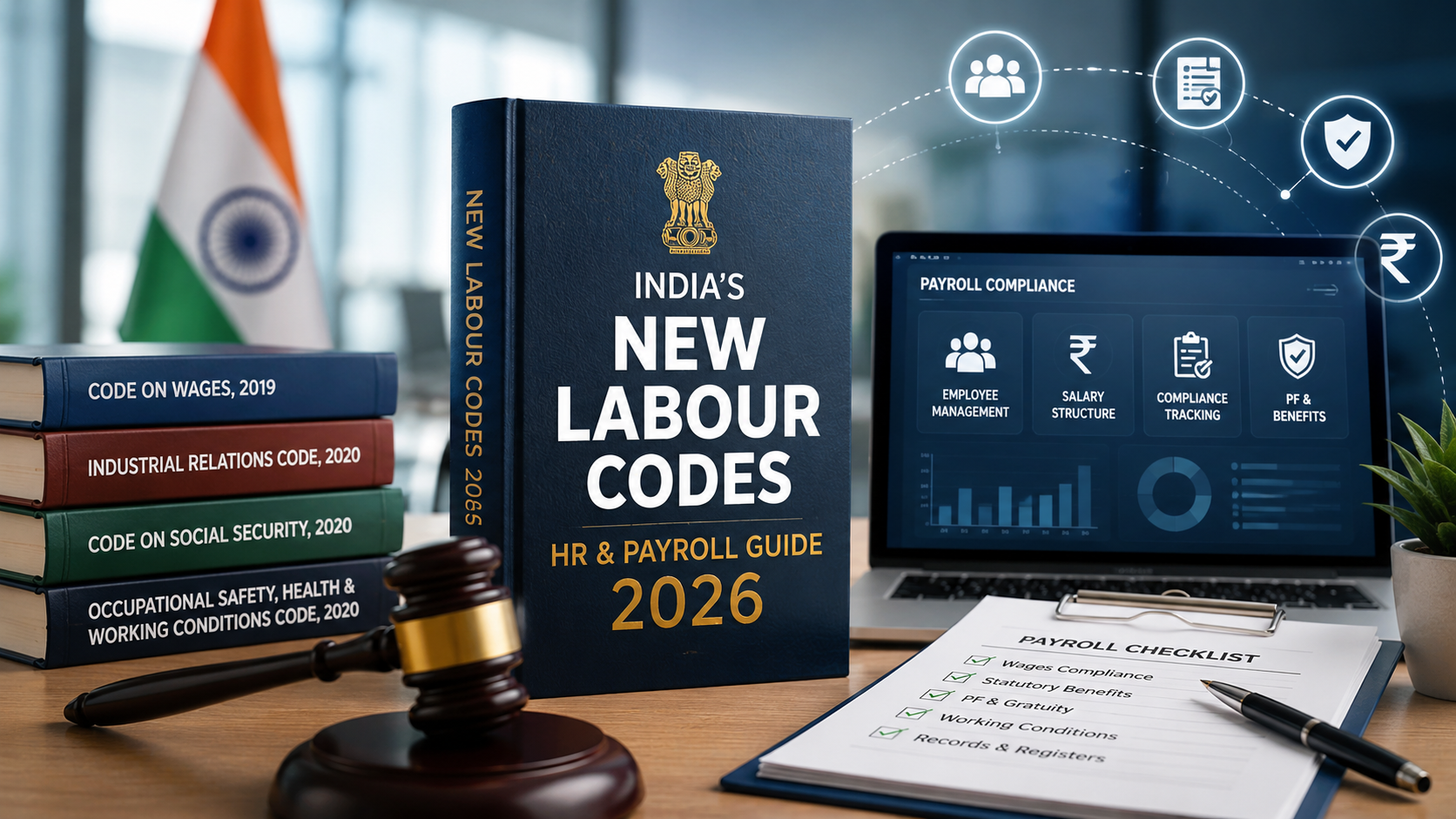
The impending rollout of the four Indian Labour Codes (Code on Wages, Social Security, Industrial Relations, and OSH Code) introduces major implications for CTC structures, gratuity liabilities, and wage components.
The Code on Wages standardizes the definition of "wages," stipulating that basic wages and allowances must comprise at least 50% of the total compensation. Organizations must possess a payroll system capable of simulating salary structure revisions and projecting the financial impact on employee take-home pay and employer statutory costs.
Payroll Data Can Help Control Workforce Costs
Payroll represents one of the single largest operating expenses for most businesses. With workforce analytics and HR MIS reports, payroll shifts from a backward-looking cost record into an early warning indicator.
For instance, if payroll data highlights a 25% surge in overtime expenditure across three consecutive months, leadership can immediately investigate: Is a particular facility understaffed? Are shift rosters inefficient? Are production targets creating unsustainable burnout? Without centralized payroll data, these operational bottlenecks remain buried in offline spreadsheets.
Payroll Is Also Becoming an Employee Experience Function
Employees interact with HR platforms most consistently around pay: "Where can I download my payslip?", "Why did my tax deduction change this month?", "What is my remaining leave balance?"
A dedicated employee self-service (ESS) portal empowers staff to download password-protected payslips, submit investment proofs, view tax computation worksheets, and request leave directly from their smartphone. Eliminating administrative friction directly fosters employee trust and retention.
AI Is Entering Payroll — But Automation Should Come First
Artificial Intelligence is rapidly entering workforce management, with ADP reporting that 96% of Indian organisations are adopting or evaluating AI-driven payroll features.
Key AI use cases include anomaly detection (flagging sudden spikes in payout or ghost entries), automated queries via AI HR chatbots, and workforce cost predictive modeling. However, AI cannot succeed atop messy spreadsheets — clean data, reliable rule engines, and automated attendance must form the foundation.
What Should a Modern Payroll System Provide?
When selecting the best payroll software in India, organizations should look for:
- 1-Click Automated Processing: Execute multi-tier salary calculations in minutes.
- Comprehensive Statutory Compliance: Automated PF, ESIC, Professional Tax, LWF, and TDS Form 16 generation.
- Real-Time Attendance Sync: Direct biometric, mobile app, and GPS geofence data integration.
- Multi-Branch & Multi-Entity Support: Unified administration across varied states and legal entities.
- Encrypted Self-Service Payslips: Mobile and web access with WhatsApp and email delivery.
- Integrated Full & Final Settlement: Seamless gratuity, notice period, and leave encashment calculations.
- Detailed MIS & Audit Logs: Instant export of cost-center and bank disbursement files.
- Transparent & Scalable Pricing: Review clear HR software pricing plans tailored for business growth.
Payroll Software vs Manual Payroll: What Changes?
| Operational Area | Manual Spreadsheet Payroll | Modern Cloud Payroll System |
|---|---|---|
| Employee Data | Fragmented in multiple Excel workbooks | Centralized, secure cloud master |
| Attendance Integration | Manual CSV copy-paste and manual adjustments | Real-time automated sync with biometrics & leave |
| Statutory Calculations | Error-prone manual formula checking | Automated rules compliant with PF, ESI, PT & TDS |
| Payslip Distribution | Manual printouts or mail merges | Instant self-service web & mobile app download |
| Workforce Cost Reports | Outdated, static, and difficult to compile | Real-time dynamic MIS and departmental dashboards |
| Audit Trail | Zero accountability for cell modifications | Granular timestamped audit logs for all changes |
7 Payroll Metrics HR Leaders Should Track in 2026
- 1. Payroll Processing Cycle Time: Measure how many hours or days it takes from attendance cut-off to salary credit.
- 2. Payroll Error & Correction Rate: Percentage of monthly payslips requiring post-run salary adjustments.
- 3. Overtime Spend Trends: Fluctuations in total overtime disbursement by facility and department.
- 4. Total Labour Cost Per Head: Consolidated employer cost factoring CTC, employer PF, ESIC, bonus, and gratuity.
- 5. Payroll-to-Headcount Ratio: Number of HR staff required per 100 employees to execute payroll.
- 6. Employee Query Volume: Frequency of routine payroll tickets submitted to HR.
- 7. Statutory Filing Exceptions: Number of non-compliance warnings or manual intervention events.
Key Takeaways for HR Leaders
- Payroll in India is evolving from a back-office administration chore into a driver of workforce intelligence in 2026.
- Accurate payroll data directly empowers budgeting, headcount forecasting, and retention strategies.
- Manual spreadsheets create severe operational and compliance risks as headcount expands across multiple states.
- Integrating employee master data, attendance, leave, and payroll eliminates duplicate entry and calculation errors.
- Self-service access to payslips and tax worksheets dramatically improves employee trust and cuts HR ticket volumes.
Frequently Asked Questions
1. What is payroll in India?
Payroll in India is the process of calculating employee compensation, applying statutory contributions (PF, ESIC, Professional Tax, TDS), disbursing salaries, generating digital payslips, and maintaining compliance records.
2. Why is payroll in India 2026 becoming more strategic?
Because payroll data reflects exact labour expenditure. Research shows 94% of organisations use payroll data to drive critical hiring, retention, and departmental budgeting decisions.
3. What features should I prioritize when choosing payroll software in India?
Ensure the solution offers automated statutory compliance calculations, biometric attendance integration, multi-state tax handling, mobile self-service payslips, and seamless HRMS connectivity.
4. Can payroll automation help ensure statutory compliance?
Yes. Modern payroll software automatically computes PF ceilings, ESIC limits, Professional Tax slabs across states, and TDS calculations under both old and new tax regimes.
Disclaimer: This article is intended for general informational purposes and should not be construed as legal, tax, or financial counsel. Employers should consult qualified compliance and tax advisors regarding specific state and statutory rules.