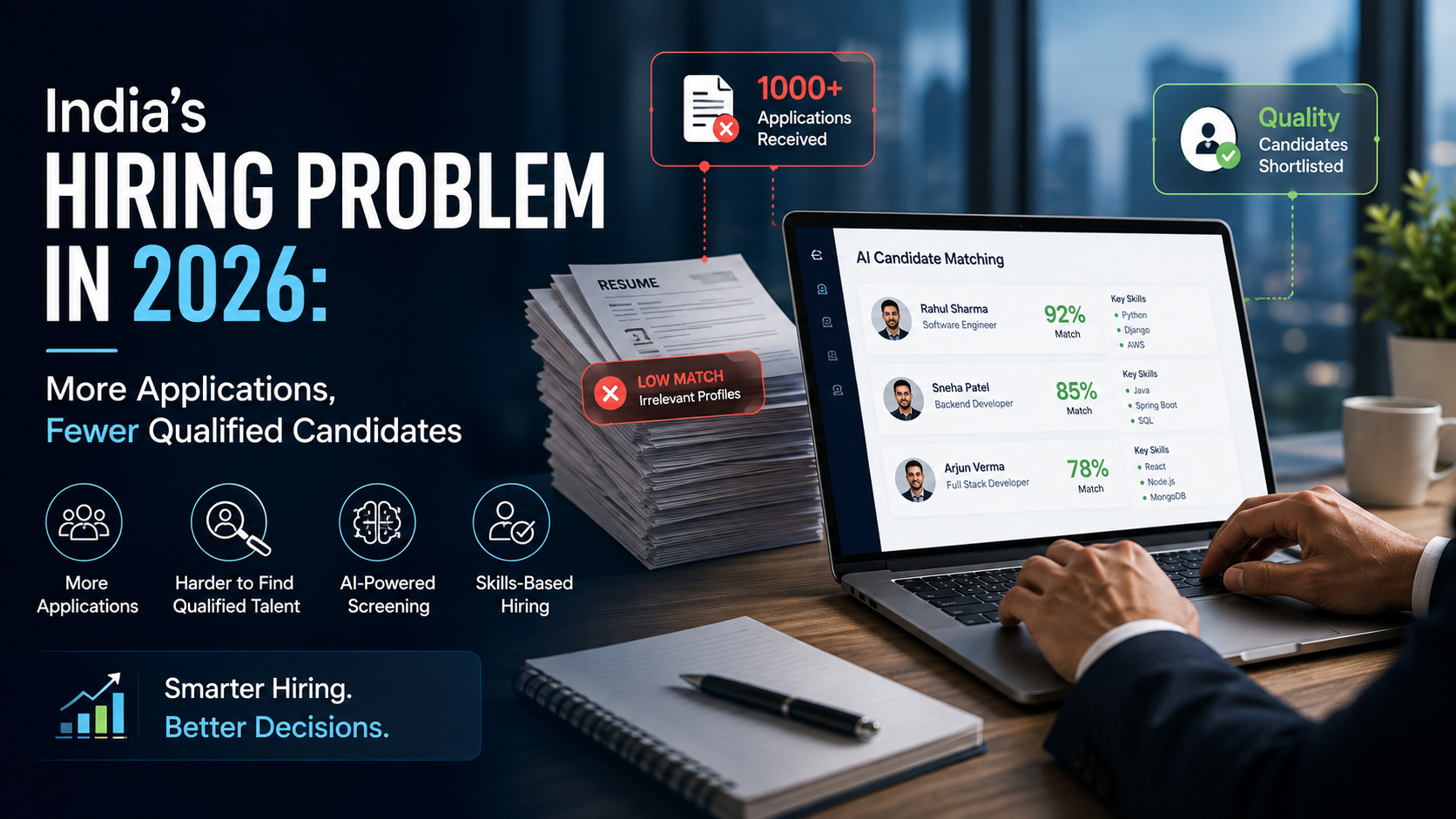
When analysing hiring challenges in India 2026, recruiters are not facing a simple shortage of resumes or job seeker interest. In fact, companies across corporate India have the exact opposite dilemma.
There is no shortage of applications. However, uncovering candidates who actually possess genuine job-specific competence, problem-solving capability, and verified technical skills has become significantly harder.
LinkedIn research reported in February 2026 revealed that 74% of recruiters in India struggle to find qualified candidates, even while national hiring activity tracks approximately 40% above pre-pandemic benchmarks. The primary driver behind these hiring challenges in India 2026 is the exponential explosion of AI-generated resumes and 1-click job board spam, which distorts talent screening.
This creates a modern talent paradox: More applications do not mean better hiring. In 2026, talent acquisition is no longer about maximizing applicant volume — it is about separating authentic capability from digital noise.
- India's Hiring Market Is Still Active in 2026
- The Recruitment Paradox: Volume vs. Quality
- AI Is Changing Both Sides of Recruitment
- A Polished Resume Does Not Equal a Qualified Candidate
- Why Skills-Based Hiring Is Becoming Crucial
- Job Descriptions Need to Become Outcome-Driven
- Why Traditional Keyword ATS Screening Fails
- What AI Should Actually Do in Recruitment
- The Modern Evidence-Based Recruitment Funnel
- The 7 Biggest Hiring Problems HR Teams Must Solve in 2026
- What Talent Teams Should Measure
- What Job Seekers Must Understand
- Modern Recruitment Technology & HRMS Integration
- A 7-Step Actionable Recruitment Strategy for 2026
- Frequently Asked Questions
India's Hiring Market Is Still Active in 2026
India’s employment landscape is far from stagnant. Naukri's JobSpeak data shows white-collar hiring across India expanded by 6% year-over-year. Specifically, Artificial Intelligence and Machine Learning roles surged by 25%, while non-IT verticals including BFSI, telecom, consumer goods (FMCG), and healthcare demonstrated steady double-digit expansion.
However, hiring growth has intensified recruiter pressure. Companies are no longer evaluating generic profiles; they demand demonstrable proficiency:
- Role-specific technical and analytical mastery
- Applied AI literacy and tool adaptability
- Complex critical thinking and cross-functional problem-solving
- High-impact communication and stakeholder management
- Documented evidence of successful project delivery
The Recruitment Paradox: Volume vs. Quality
Traditional hiring operated under a straightforward mathematical assumption: More applicant volume yields a superior final hire.
In 2026, that assumption has broken down completely. When a company posts a vacancy on job boards and receives 1,200 applications within 48 hours, recruiters face a crippling signal-to-noise bottleneck:
- Over 70% of inbound CVs are generic, mismatched, or AI-generated spam
- Recruiters burn dozens of hours manually triaging low-intent submissions
- Qualified, high-impact candidates get buried in the resume avalanche and accept rival offers
- Candidate experience deteriorates due to sluggish response intervals
AI Is Changing Both Sides of Recruitment
Generative AI and Agentic automation are concurrently reshaping candidate behaviors and employer methodologies.
Deloitte India’s Campus Workforce Trends research found that 86% of organisations report AI or Agentic AI is actively transforming recruitment operations. Top enterprise use cases include resume parsing (72%), automated skill assessments (48%), and conversational AI HR chatbots (37%).
| Dimension | How Candidates Use AI | How Modern Employers Use AI |
|---|---|---|
| Application Crafting | Generating hyper-tailored resumes and cover letters | Semantic contextual parsing beyond exact keyword matches |
| Speed & Sourcing | Submitting 50+ 1-click job applications daily | Automated candidate rediscovery inside existing talent pools |
| Evaluation | AI interview prep and algorithmic keyword stuffing | Objective, work-sample simulation and skill scorecards |
A Polished Resume Does Not Equal a Qualified Candidate
One of the greatest hiring challenges in India 2026 is the disconnect between presentation and verified competence. With modern LLMs, anyone can construct an impeccable resume highlighting flawless executive summaries.
Smart talent acquisition teams treat the CV as an introductory signal rather than proof of competence. True candidate quality must be validated through structured work simulations, past project repositories, and standardized competency benchmarks.
Why Skills-Based Hiring Is Becoming Crucial
Traditional pedigree hiring—screening solely by college brand or prior employer name—is giving way to skills-first recruitment.
Michael Page’s Talent Trends India report revealed that 39% of hiring managers now prioritize functional capability and practical skills over formal degrees or rigid career history. Evaluating what a candidate can tangibly build or execute opens non-traditional talent pipelines while driving superior on-the-job retention.
Job Descriptions Need to Become Outcome-Driven
Vague, copy-pasted job descriptions attract ambiguous applicant pools. To attract genuinely qualified talent, job specifications must outline measurable outcomes:
"Looking for a dynamic marketing manager with excellent communication skills and 5 years experience."
"Lead B2B SaaS demand generation: Own ₹5 Cr quarterly pipeline target, optimize HubSpot attribution, and manage paid acquisition budgets."
Why Traditional Keyword ATS Screening Fails
First-generation Applicant Tracking Systems relied strictly on exact keyword matching. If a job requisition demanded "Enterprise Account Management", an ATS would reject a standout candidate whose resume cited "Key Client Relationship Leadership".
Modern recruitment management and ATS software utilizes semantic contextual matching. It grasps skill adjacencies, career trajectories, and industry-specific terminology to rank talent accurately without discarding high-potential candidates.
What AI Should Actually Do in Recruitment
AI in recruitment must never replace human empathy, cultural evaluation, or final hiring discretion. Instead, AI functions best as an administrative copilot:
- Automated Resume Parsing: Ingesting unstructured PDF/Word resumes into structured candidate profiles
- Intelligent Candidate Matching: Comparing skills, tenure, and location against role scorecards
- Talent Pool Rediscovery: Surfacing silver-medalist applicants already sitting in your talent management database
- Automated Interview Scheduling: Eliminating back-and-forth calendar coordination
- Real-Time Analytics: Pinpointing bottlenecks in the recruiting funnel via HR MIS reporting
The Modern Evidence-Based Recruitment Funnel
To overcome high-volume applicant noise, high-performing talent acquisition teams are restructuring their hiring funnel:
Targeted Sourcing → Semantic AI Match → Skills Benchmark → Structured Scorecard Interview → Offer → Seamless Onboarding
Connecting recruitment directly into an integrated HRMS software platform ensures that new hires transition instantly into employee records, biometric attendance, and payroll without manual data re-entry.
The 7 Biggest Hiring Problems HR Teams Must Solve in 2026
- High Inbound Noise: Deploy pre-application qualification screening questions.
- Synthetic AI Resumes: Incorporate live scenario-based problem-solving during interviews.
- Rigid Keyword Filtering: Transition to modern, semantic ATS technology.
- Slow Candidate Follow-ups: Automate status updates to protect employer brand reputation.
- Niche Skill Scarcity: Build warm talent pipelines and internal upskilling initiatives.
- Interviewer Subjectivity: Implement standardized scorecards aligned with performance management standards.
- Post-Offer Dropout: Engage offered candidates through digital onboarding portals before day one.
What Talent Teams Should Measure
Forward-thinking HR leaders have stopped measuring success by raw application tallies. High-yield recruitment metrics include:
- Qualified Candidate Ratio: Percentage of inbound applicants advancing past initial screening
- Time to Shortlist: Business days required to deliver 3 interview-ready candidates to the hiring manager
- Interview-to-Offer Ratio: Precision indicator of screening effectiveness
- Offer Acceptance Rate: Strength of employer brand, compensation packaging, and candidate connection
- Quality of Hire (90-Day Review): First-quarter employee performance ratings and retention rate
What Job Seekers Must Understand
Candidates must recognize that keyword stuffing and AI-massaged resumes are rapidly losing efficacy. Deloitte found that demonstrated applied AI and analytical skills command a 20–25% hiring salary premium in India. Professionals must curate tangible proof: live GitHub repositories, published case studies, certified credentials, and measurable business outcomes.
Modern Recruitment Technology & HRMS Integration
Standalone recruitment spreadsheets create data silos that sever recruiting from post-hire performance. By linking talent acquisition directly with payroll, attendance, and performance, companies ensure continuous workforce intelligence.
Organizations can review transparent HR software pricing plans to evaluate end-to-end recruitment platforms or schedule a live product demo to see modern ATS automation in action.
A 7-Step Actionable Recruitment Strategy for 2026
- Step 1: Identify must-have competencies vs. trainable skills for each open requisition.
- Step 2: Rewrite job postings to emphasize real-world deliverables and quarterly milestones.
- Step 3: Configure smart semantic filters to eliminate generic resume spam.
- Step 4: Introduce lightweight practical work samples prior to final interviews.
- Step 5: Standardize interview panels with objective scoring rubrics.
- Step 6: Measure qualified candidate ratios rather than total top-of-funnel clicks.
- Step 7: Leverage technology to accelerate communication while keeping humans in charge of final hiring.
Key Takeaways for HR Leaders
- Hiring challenges in India 2026 center on separating authentic talent from massive applicant noise.
- 74% of recruiters struggle to identify qualified candidates despite rising overall application volumes.
- Skills-based hiring and practical work samples provide far superior predictive accuracy than resumes alone.
- Modern semantic ATS platforms streamline candidate matching while preserving recruiter judgement.
- Connecting recruitment with core HRMS creates a seamless employee journey from job offer to payroll.
Frequently Asked Questions
1. Why are hiring challenges in India 2026 intensifying despite more applications?
Because 1-click job boards and automated AI tools make submitting resumes effortless. This leads to massive application volume, but with a drastically lower percentage of genuinely qualified, role-ready talent.
2. How does skills-based hiring improve candidate quality?
Skills-based hiring focuses on direct evidence of capability through practical assessments and work simulations, expanding talent pools while filtering out candidates who merely have polished resumes.
3. Can AI recruitment software replace human interviewers?
No. AI excel at parsing resumes, matching skills, and scheduling interviews. However, critical decisions regarding cultural alignment, motivation, ethical judgement, and final selection remain firmly in human hands.
4. What features should modern ATS software provide?
Ensure the solution includes semantic keyword parsing, talent pool rediscovery, customizable scorecard interviews, automated candidate messaging, and seamless integration with your payroll and HRMS platform.
Disclaimer: This article is intended for general informational purposes and does not constitute legal, recruitment, or employment advice. Organizations should customize hiring processes to their specific operational requirements and local employment regulations.