India's labour compliance framework is undergoing one of its biggest changes in decades.
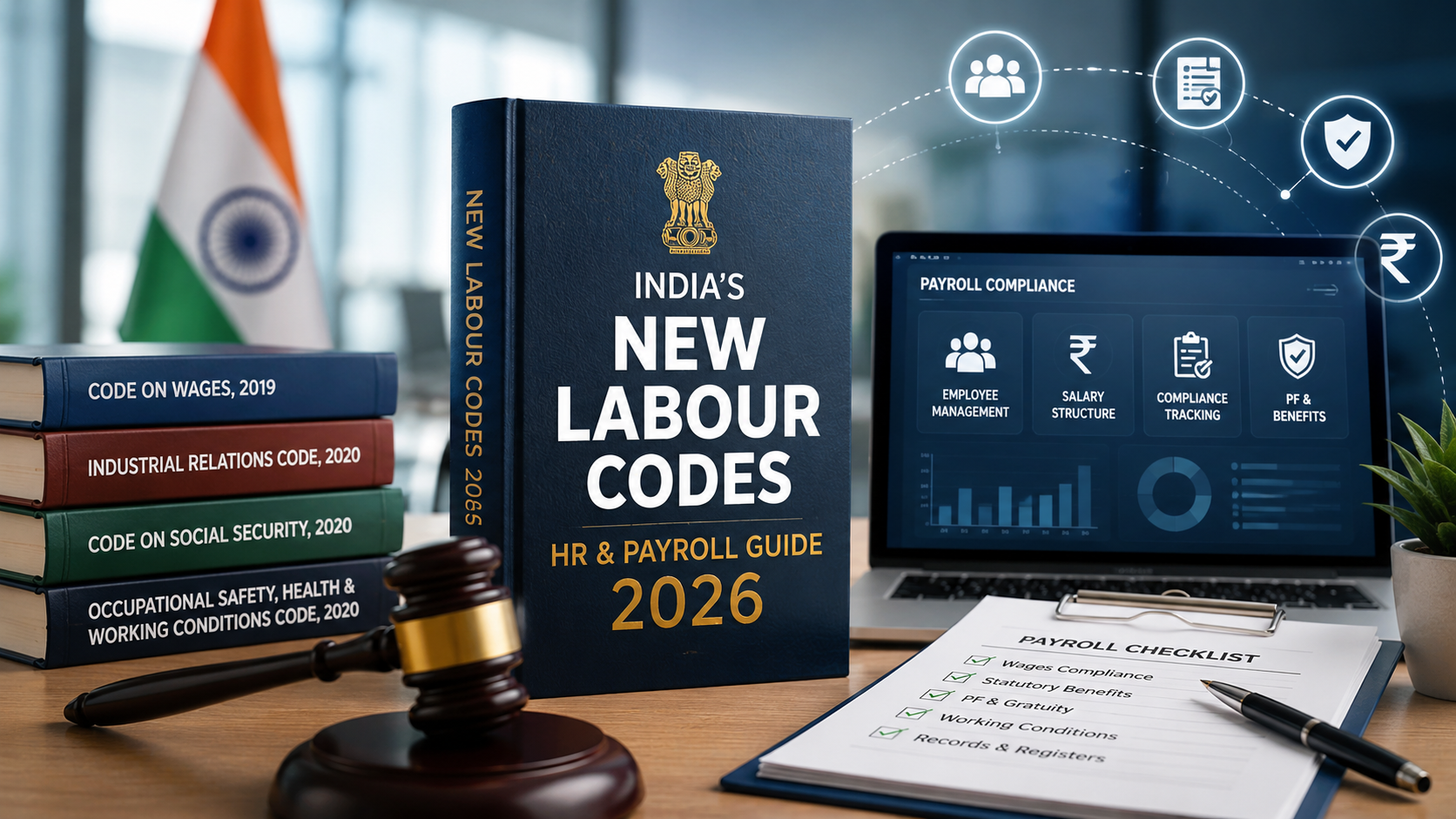
The country's four Labour Codes — the Code on Wages, 2019; Industrial Relations Code, 2020; Code on Social Security, 2020; and Occupational Safety, Health and Working Conditions Code, 2020 — came into force on 21 November 2025, replacing and consolidating 29 central labour laws.
In 2026, the focus has shifted from the legislation itself to operational readiness and state-level implementation.
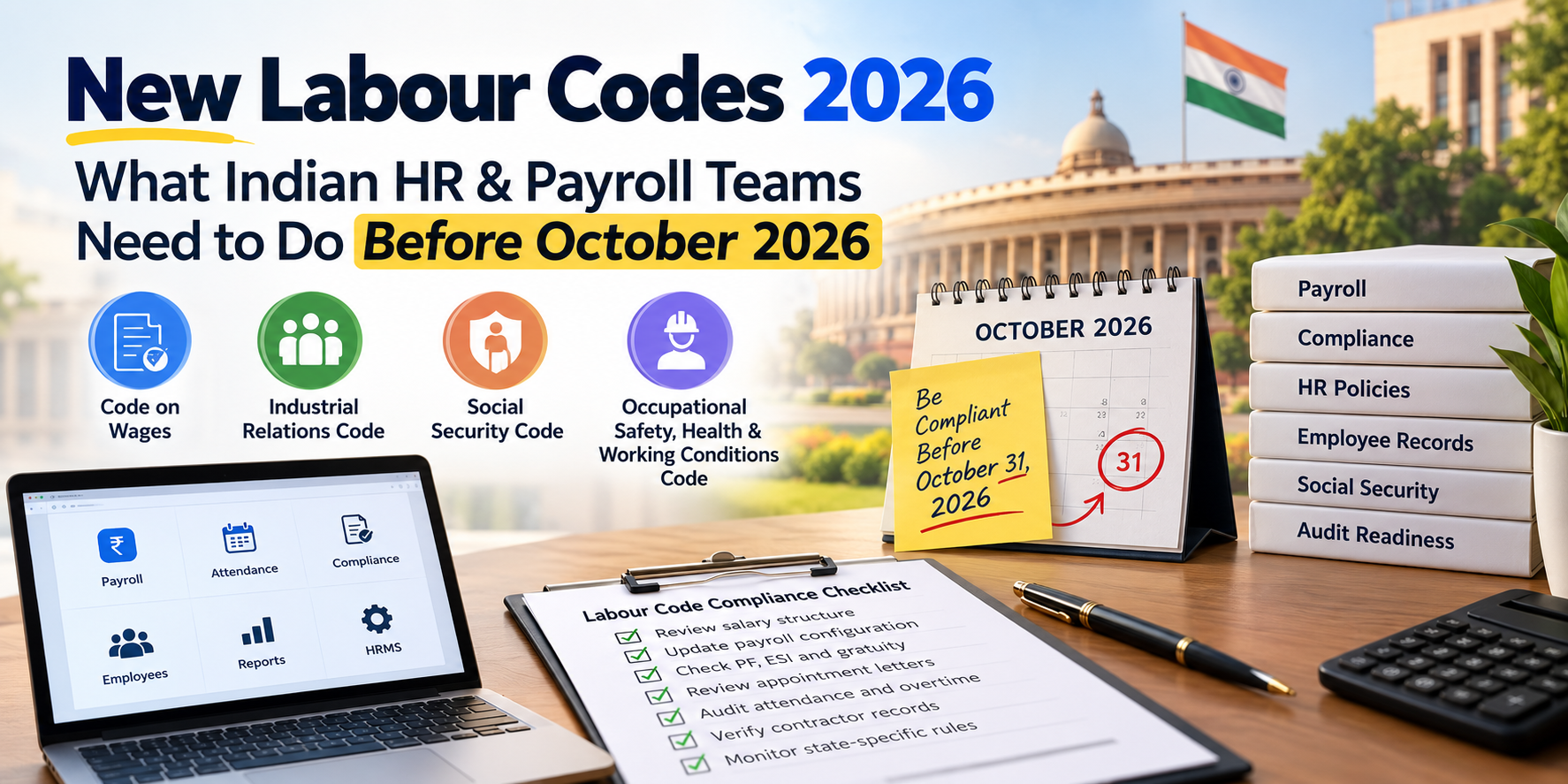
The Central Government has notified rules under the four Codes, and the Labour Ministry has said it expects all states and Union Territories to publish their respective rules by 31 October 2026. As of late September, 10 states and UTs had already published final rules, while others had issued draft rules for consultation.
For HR and payroll teams, this means that 2026 should be treated as a compliance-readiness year. Companies should not wait until the final state rules are published before reviewing salary structures, employee records, appointment letters, payroll configurations, working-hour policies, contractor data, social-security processes and HRMS systems.
This guide explains what Indian employers should review before October 2026 and how HR technology can help manage the transition.
- Quick Answer: What Should HR Teams Do Before October 2026?
- What Are India's Four New Labour Codes?
- Why October 2026 Matters for HR Teams
- 1. Review Your Salary Structure & The 50% Wage Rule
- 2. Audit Your Payroll Software
- 3. Review Appointment Letters & Employment Contracts
- 4. Review Attendance and Working Hours
- 5. Check Overtime Calculations
- 6. Review PF, ESI, and Social Security Processes
- 7. Review Contract and Gig Workers
- 8. Review Women Employee and Night-Shift Policies
- 9. Review Health and Safety Compliance
- 10. Prepare for State-Wise Compliance
- 11. Review Your HR Registers and Records
- 12. Create a Labour Code Compliance Calendar
- 13. Train HR, Payroll and Finance Teams
- 14. Build a Labour Code Readiness Checklist
- How HRMS Software Can Help With Labour Code Readiness
- Why HRMS Is Becoming More Important in 2026
- What Should Companies Do in September and October 2026?
- Frequently Asked Questions About India's Labour Codes 2026
- Final Takeaway & Disclaimer
- Sources & Further Reading
Quick Answer: What Should HR Teams Do Before October 2026?
Before the October 2026 state-rule milestone, HR and payroll teams should execute this 15-point compliance checklist:
- Review the company's salary and wage structure.
- Check the definition and calculation of "wages" under the new framework.
- Review appointment letters and employment documentation.
- Audit PF, ESI and other statutory payroll configurations.
- Review overtime and working-hour calculations.
- Check leave, attendance and working-time records.
- Review contractor and contract-worker records.
- Prepare for applicable social-security requirements.
- Review policies covering women employees and night work.
- Check health and safety compliance requirements.
- Review employee and employer registers.
- Ensure payroll and HRMS software can support changing statutory rules.
- Track state-specific Labour Code notifications.
- Maintain an audit trail for compliance changes.
- Train HR, payroll, finance and compliance teams.
*Note: The exact requirements can vary depending on the applicable Code, establishment, industry, workforce composition and state rules. Companies should verify the final rules and obtain professional legal advice where necessary.
What Are India's Four New Labour Codes?
India consolidated 29 central labour laws into four broad Labour Codes. The Government says the framework is intended to simplify compliance while strengthening provisions relating to wages, industrial relations, social security, occupational safety and working conditions.
The four Codes are:
| Labour Code | Main Area & Laws Consolidated |
|---|---|
| Code on Wages, 2019 | Minimum wages, payment of wages, bonus and wage-related provisions. (Replaces 4 acts including Payment of Wages Act, Minimum Wages Act, Payment of Bonus Act). |
| Industrial Relations Code, 2020 | Industrial disputes, trade unions and employment relations. (Replaces Trade Unions Act, Industrial Employment Standing Orders Act, Industrial Disputes Act). |
| Code on Social Security, 2020 | EPF, ESI, gratuity, maternity and social-security provisions. Extends social security coverage to gig, platform, and fixed-term workers. (Replaces 9 acts). |
| Occupational Safety, Health and Working Conditions Code, 2020 | Workplace safety, health, working conditions and related requirements. (Replaces 13 acts including Factories Act, Contract Labour Act). |
The Government's own summary says the framework rationalises multiple registrations, forms, registers and returns and introduces greater use of electronic compliance mechanisms.
Why October 2026 Matters for HR Teams
October 2026 is important because the Central Government has indicated that it expects all states and Union Territories to publish their rules under the four Labour Codes by 31 October 2026.
Labour is a subject involving both the Centre and states (Concurrent List). As a result, companies operating across multiple states cannot assume that a single compliance configuration will automatically cover every location.
For HR departments, the practical question is therefore not simply:
"Are the Labour Codes implemented?"
It is:
"Is our organisation ready to operate under the applicable central and state rules?"
This distinction is particularly important for companies with:
- Multiple offices
- Factories
- Warehouses
- Retail locations
- Contract workers
- Field employees
- Migrant workers
- Remote employees
- Employees working night shifts
- Large payrolls
- Operations across multiple states
1. Review Your Salary Structure
One of the most important areas for payroll teams is the treatment of wages.
The Code on Wages introduces a common definition of wages across the four Codes. The Government has also highlighted provisions concerning allowances exceeding the prescribed threshold being included in wages for specified statutory calculations. Under this 50% wage rule, Basic Pay + Dearness Allowance must comprise at least 50% of total CTC. If allowances exceed 50%, the surplus is added back into the wage base.
This means HR and payroll teams should review the structure of:
- Basic salary
- Dearness allowance
- House rent allowance
- Special allowance
- Conveyance allowance
- Other allowances
- Bonus
- Incentives
- Overtime
- Statutory contributions
What HR should do
Run a salary-structure audit for every employee category.
Employee → Gross Salary → Basic → Allowances → Statutory Wage Components → PF/ESI/Gratuity Impact
Do not assume that an existing salary structure will automatically remain appropriate under the new framework. You can simulate compensation adjustments using our free CTC Calculator and generate sample monthly pay records with our Payslip Generator.
The final calculation depends on the applicable legal provisions and rules, so payroll teams should validate their configuration against the latest notifications.
2. Audit Your Payroll Software
A spreadsheet-based payroll process becomes increasingly difficult when statutory rules, employee categories and state-level requirements change.
Your payroll system should allow HR teams to manage:
- Salary components
- Wage definitions
- PF
- ESI
- TDS
- Professional Tax
- Labour Welfare Fund
- Gratuity
- Bonus
- Overtime
- Full & Final Settlement
- Statutory reports
- Employee classifications
- State-specific rules
A modern HRMS should also maintain an audit trail showing when a payroll rule or employee configuration was changed.
HRMS checklist
Ask your payroll software provider:
- Can the system update statutory calculations without rebuilding payroll manually?
- Can different branches have different state-specific configurations?
- Can payroll changes be tracked and audited?
- Can HR generate statutory reports quickly?
If the answer to these questions is no, 2026 is a good time to review your payroll technology. Discover how HR Niti Payroll Software automates multi-state Indian compliance.
3. Review Appointment Letters
The Labour Codes introduce important requirements relating to employment documentation. The Government has highlighted appointment letters as one of the mandatory measures under the new framework.
HR teams should therefore review whether every employee receives appropriate employment documentation.
Check:
- Employee name and designation
- Date of joining
- Employment type
- Salary
- Wage components
- Working hours
- Place of work
- Leave entitlement
- Statutory benefits
- Notice period
- Applicable policies
Companies should also ensure that their HRMS can generate and store appointment letters digitally. You can utilize pre-vetted formats like the Standard Job Offer Letter Template from our HR Templates Library.
4. Review Attendance and Working Hours
Labour compliance is closely connected to attendance data.
Your attendance system should accurately capture:
- Employee check-in
- Employee check-out
- Working hours
- Overtime
- Weekly offs
- Holidays
- Leave
- Late arrivals
- Early departures
- Shift schedules
- Night shifts
For organisations with multiple branches, manual attendance sheets can create inconsistencies between HR, payroll and statutory records.
A connected HRMS like HR Niti Attendance Management allows:
Attendance → Leave → Overtime → Payroll
to operate as one unified, tamper-proof workflow.
5. Check Overtime Calculations
Payroll teams should review how overtime is:
- Recorded
- Approved
- Calculated (at double normal wage rates)
- Paid
- Reported
The HRMS should ideally maintain an auditable record of overtime approvals and payments through connected Timesheet Management.
For manufacturing, healthcare, hospitality, logistics, security, retail and other shift-based businesses, this becomes particularly important.
6. Review PF and Social Security Processes
The Code on Social Security expands and reorganises India's social-security framework. The Government has specifically highlighted coverage for organised, unorganised, gig and platform workers within the broader framework.
HR teams should review:
- Employee PF records
- ESI records
- UAN information
- Employee nominations
- Gratuity eligibility (including 1-year eligibility for Fixed-Term Employees)
- Maternity-related benefits
- Contractor workforce information
- Social-security documentation
The EPFO employer portal is also carrying current information and FAQs concerning recent EPF wage-ceiling changes, so payroll teams should check official EPFO notifications rather than relying on older payroll assumptions. You can estimate contributions with our EPF Calculator India and verify gratuity payouts using our Gratuity Calculator.
7. Review Contract and Gig Workers
Modern businesses increasingly depend on:
- Contract workers
- Temporary workers
- Staffing agencies
- Delivery workers
- Gig workers
- Platform workers
- Consultants
The Code on Social Security specifically recognises newer forms of employment, including gig and platform workers.
HR teams should maintain accurate records of workers engaged through contractors and staffing agencies. Important information may include:
- Contractor name
- Worker name
- Job role
- Work location
- Joining date
- Contract period
- Wage information
- Statutory registration
- Attendance
- Vendor details
- Compliance documents
8. Review Women Employee and Night-Shift Policies
The new labour framework includes provisions concerning women's employment, including work in establishments and night shifts subject to applicable conditions and safeguards.
Companies should review:
- Night-shift policy
- Consent requirements where applicable
- Transportation
- Workplace safety
- Security
- Shift scheduling
- POSH compliance
- Emergency contacts
The exact requirements can depend on applicable rules and establishment-specific conditions.
9. Review Health and Safety Compliance
The Occupational Safety, Health and Working Conditions Code covers workplace safety and health requirements.
The Government has highlighted provisions concerning annual health check-ups for specified employees and workplace safety requirements.
HR and administration teams should review:
- Workplace safety policies
- Health check-up records
- Safety training
- Incident reporting
- Emergency procedures
- Protective equipment
- Contractor safety
- Factory/establishment records
For factories, construction companies, warehouses and industrial businesses, this area deserves particular attention.
10. Prepare for State-Wise Compliance
This is one of the most important steps for companies operating across India.
A company with offices in:
Uttar Pradesh + Maharashtra + Karnataka + Delhi
may need to monitor different state-level rules, notifications and implementation requirements. Therefore, HRMS software should support location-wise compliance configuration.
Create a compliance matrix like this:
| State | Wages | Social Security | IR | OSH | Status |
|---|---|---|---|---|---|
| Uttar Pradesh | Monitor | Monitor | Monitor | Monitor | Check latest notification |
| Maharashtra | Monitor | Monitor | Monitor | Monitor | Check latest notification |
| Karnataka | Monitor | Monitor | Monitor | Monitor | Check latest notification |
| Delhi | Monitor | Monitor | Monitor | Monitor | Check latest notification |
Important: Do not copy a state status from an old article or third-party tracker without checking the latest government notification. The Ministry of Labour maintains a dedicated Labour Codes portal containing the Codes, rules, notifications, FAQs and related material.
11. Review Your HR Registers and Records
The Government has stated that the new framework aims to reduce the number of forms and registers and increase electronic compliance.
HR teams should identify:
- Which registers are currently maintained?
- Which registers will change?
- Which records need employee-level data?
- Which records are branch-specific?
- How long should records be retained?
- Who has access?
- Can the records be exported during an inspection?
A digital HRMS can help maintain a central employee record while keeping branch and statutory information organised through HR MIS Reports.
12. Create a Labour Code Compliance Calendar
Don't treat Labour Code compliance as a one-time project. Create a recurring compliance calendar containing:
Monthly
- Payroll validation
- PF/ESI checks
- Attendance reconciliation
- Overtime validation
- Leave reconciliation
- Employee master-data audit
Quarterly
- Compliance review
- Contractor documentation review
- Salary structure review
- Statutory report audit
Annually
- Policy review
- Health and safety review
- Employee documentation audit
- Compliance training
- HRMS configuration review
13. Train HR, Payroll and Finance Teams
Technology alone does not create compliance.
HR, payroll, finance and operations teams should understand how the new framework affects their responsibilities. Training should cover:
- Wage structure
- Payroll calculations
- Employee documentation
- Attendance
- Overtime
- Social security
- Contractor management
- State-specific compliance
- Record keeping
- Compliance audits
A short internal Labour Code training programme can help reduce errors when new rules become operational.
14. Build a Labour Code Readiness Checklist
Use this checklist before October 2026:
Payroll
- [ ] Salary structures reviewed
- [ ] Wage components audited
- [ ] PF configuration reviewed
- [ ] ESI configuration reviewed
- [ ] Gratuity configuration reviewed
- [ ] Overtime calculation reviewed
- [ ] Payroll reports reviewed
HR
- [ ] Appointment letters reviewed
- [ ] Employee records updated
- [ ] Employment contracts reviewed
- [ ] Leave policies reviewed
- [ ] Working-hour policies reviewed
- [ ] Night-shift policies reviewed
- [ ] Contractor records reviewed
Compliance
- [ ] State rules monitored
- [ ] Central rules reviewed
- [ ] Statutory registers reviewed
- [ ] Compliance calendar created
- [ ] Audit documentation organised
- [ ] HR team trained
Technology
- [ ] HRMS supports statutory configuration
- [ ] Payroll supports updated rules
- [ ] Attendance integrates with payroll
- [ ] Digital employee records available
- [ ] Audit trails enabled
- [ ] Reports can be exported
- [ ] Multi-state configuration supported
How HRMS Software Can Help With Labour Code Readiness
The Labour Code transition creates a strong case for connecting HR, attendance and payroll systems.
Instead of maintaining separate spreadsheets for:
Employees → Attendance → Leave → Payroll → Compliance
companies can use an integrated HRMS.
For example:
This reduces repetitive data entry and gives HR teams a consistent employee record.
For growing Indian businesses, HRMS can also help manage multiple branches, employee hierarchies, attendance, payroll, recruitment, documents and statutory processes from a central platform.
Why HRMS Is Becoming More Important in 2026
The labour compliance environment is becoming increasingly data-driven.
An HR department may need to manage thousands of employee records while maintaining accurate information about:
- Salary
- Attendance
- Leave
- Working hours
- Overtime
- PF
- ESI
- TDS
- Gratuity
- Employee documents
- Branch
- Department
- Designation
- Employment type
Manual processes make it harder to maintain consistency. An HRMS can provide a single source of employee information and connect HR operations with payroll.
For companies preparing for the 2026 Labour Code environment, the objective should not simply be "change the payroll formula."
It should be:
Build a complete, auditable and technology-supported HR compliance process.
What Should Companies Do in September and October 2026?
HR teams do not need to wait until October 31. A practical timeline is:
September 2026
- Step 1: Audit current HR and payroll processes.
- Step 2: Identify employees and branches affected by Labour Code requirements.
- Step 3: Review salary structures.
- Step 4: Review appointment letters and employment documentation.
- Step 5: Review PF, ESI, gratuity and payroll configurations.
- Step 6: Start monitoring state-specific notifications.
October 2026
- Step 7: Compare final state rules with your compliance matrix.
- Step 8: Update HR policies.
- Step 9: Update payroll and HRMS configurations.
- Step 10: Conduct test payroll runs.
- Step 11: Train HR and payroll teams.
- Step 12: Maintain documentation of the changes made.
Frequently Asked Questions About India's Labour Codes 2026
1. When did India's four Labour Codes come into force?
The four Labour Codes came into force on 21 November 2025. They consolidated 29 central labour laws into four Codes.
2. Why is October 31, 2026 important?
The Labour Ministry has said it expects all states and Union Territories to publish their Labour Code rules by 31 October 2026, supporting full operationalisation of the framework at the state level.
3. What are the four Labour Codes?
They are: (1) Code on Wages, 2019; (2) Industrial Relations Code, 2020; (3) Code on Social Security, 2020; and (4) Occupational Safety, Health and Working Conditions Code, 2020.
4. Do the Labour Codes affect payroll?
Yes. Payroll teams need to review wage definitions, salary components and applicable statutory calculations under the new framework and relevant rules.
5. Will salary structures change because of the Labour Codes?
Salary structures may require review depending on how an organisation's existing salary components interact with the applicable definition of wages and statutory calculations. Employers should conduct an employee-level payroll impact assessment rather than applying a blanket change.
6. Do Labour Codes apply to companies in every state?
The four Codes form the national framework, but state-level rules and establishment-specific requirements remain important. Companies operating in multiple states should monitor the applicable state rules.
7. Do HRMS systems need to be updated?
Companies should review whether their HRMS and payroll systems can accommodate updated wage calculations, statutory rules, state-specific configurations, employee records and reporting requirements.
8. Do Labour Codes cover gig and platform workers?
The Code on Social Security includes provisions recognising gig workers and platform workers and provides a framework for social-security schemes for these categories.
9. What should HR teams do before October 2026?
HR teams should audit salary structures, payroll, employee documentation, attendance, overtime, social-security processes, contractor records, workplace policies and state-specific compliance requirements.
10. Where can employers find official Labour Code information?
The Ministry of Labour & Employment maintains an official Labour Codes section containing Codes, rules, notifications, FAQs and related information. Employers should use official notifications when determining their compliance obligations.
Final Takeaway
The Labour Codes are not simply a legal change for HR departments to read about.
They are an operational change involving:
People + Payroll + Policies + Attendance + Compliance + Technology.
With the Central Government targeting 31 October 2026 for states and UTs to publish their rules, HR and payroll teams should use September and October to identify gaps rather than waiting for the final notification cycle to finish.
For employers, the most practical approach is to:
Audit → Understand → Configure → Test → Document → Monitor.
An integrated HRMS can help organisations connect employee records, attendance, leave, payroll and compliance workflows, making it easier for HR teams to manage an increasingly complex workforce environment.
Disclaimer: This article is for general informational purposes and should not be treated as legal advice. Labour Code requirements can vary based on the applicable Code, rules, establishment, industry, employee category and state/UT. Employers should verify the latest Central and state government notifications and consult a qualified labour-law professional for organisation-specific advice.
Sources & Further Reading
- Ministry of Labour & Employment — Labour Codes, Rules, Notifications and FAQs.
- Ministry of Labour & Employment — Government information on the four Labour Codes and their implementation.
- Financial Express — September 2026 update on the Centre's October 31 state-rule target.
- EPFO — Employer portal and current statutory updates.